Cultivars & Stake Holder Engagement
We at North Carolina Agricultural and Technical State University also known as Aggie Land - have studied these 10 ginger cultivars: Big Kahuna (BK), Brazilian Giant (BG), Bubba Blue (BB), Buffalo Gung (BFG), Chinese White (CW), Hawaii Yellow (HY), Kali Ma (KM), Khing Yai (KY), Madonna (MD), and Peruvian Yellow (PY). Fresh baby ginger has typically sold for $15 to $20 per pound at farmers' markets in North Carolina for the past 15+ years. However, since 2020, baby ginger can sell for up to more than $30 per pound at farmers' markets in North Carolina. Therefore, there is an increased potential for much higher profits for the small diversified production farmers we serve.
Ginger Cultivar Comparison: Traditional vs. Micropropagated
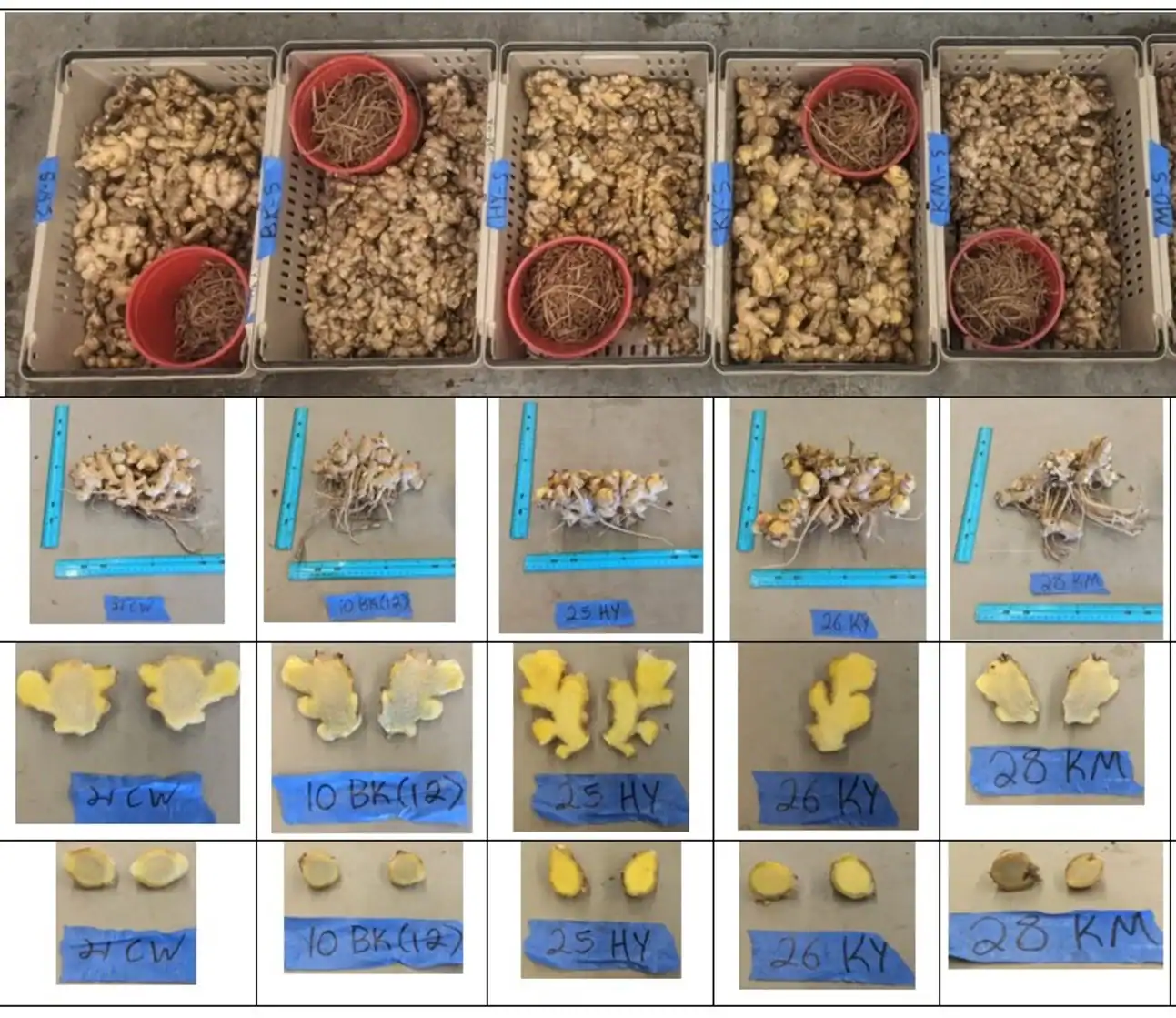
Figure A: Traditional Seed-Sprouted Ginger
Cultivars (left to right): Chinese White (CW), Big Kahunna (BK), Hawaii Yellow (HY), Khing Yai (KY), Kali Ma (KM), Madonna (MD), and Bubba Blue (BB).
-
Row 1 (Rhizome Total Yield): Harvested yield in storage bins with root buckets.
-
Row 2 (Individual Rhizome): Single plant clusters with blue rulers for scale.
-
Row 3 (Cross Section): Horizontal cuts showing flesh color variations.
-
Row 4 (Cross section): Vertical cuts showing profile and interior color.
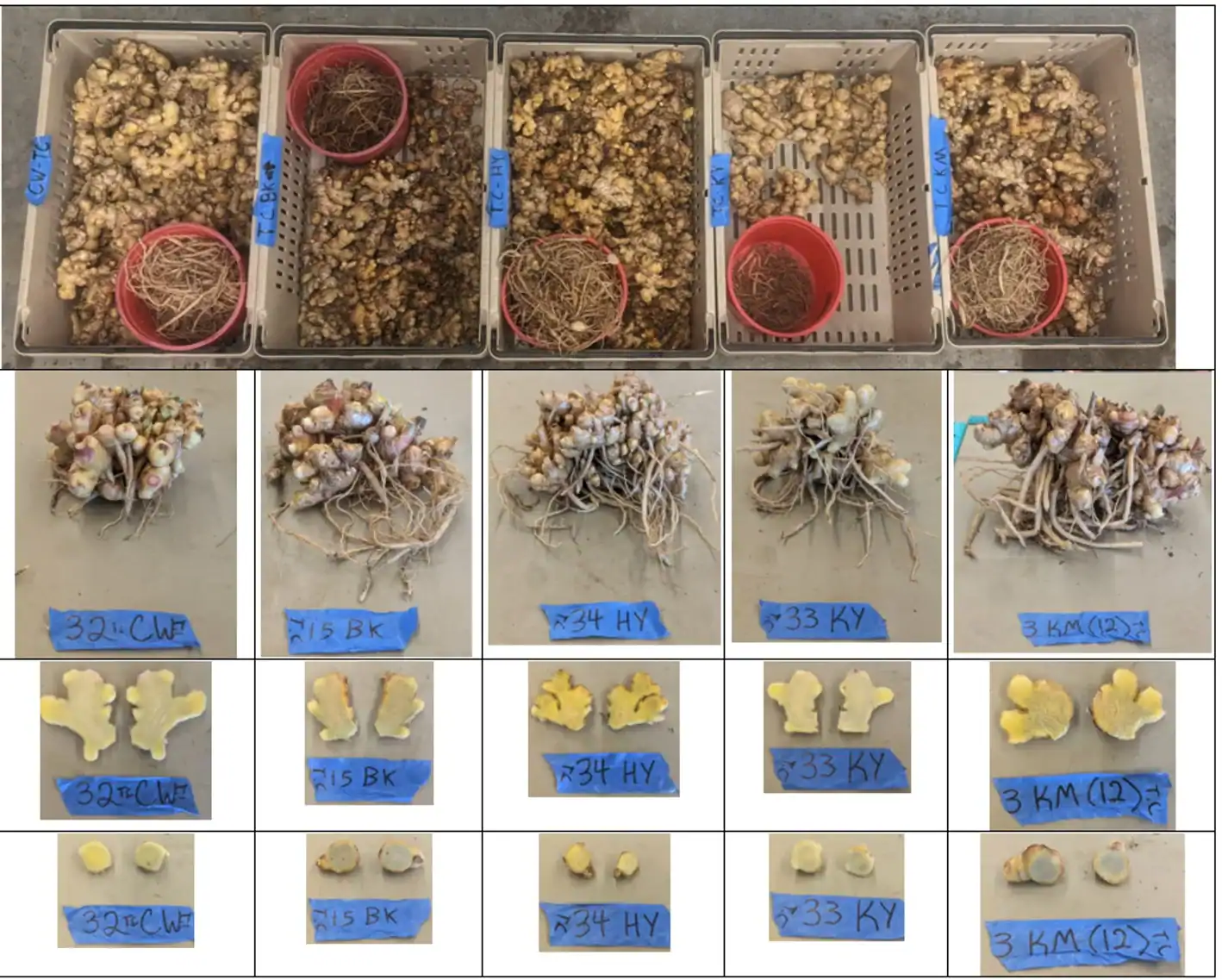
Figure B: Micropropagated Ginger
Cultivars (left to right): Chinese White (CW), Big Kahunna (BK), Hawaii Yellow (HY), Khing Yai (KY), Kali Ma (KM), Madonna (MD), and Bubba Blue (BB).
-
Row 1 (Rhizome Total Yield): Harvested tissue-culture yield in storage bins with root buckets.
-
Row 2 (Individual Rhizome): Single tissue-culture plant clusters with blue rulers for scale.
-
Row 3 (Cross Section): Horizontal cuts showing flesh color variations.
-
Row 4 (Cross section): Vertical cuts showing profile and interior color.
Stakeholder Field Trials & Outreach
Our ginger team has been closely working with and actively engaging our stakeholders in our ginger research by conducting field trials at stakeholders' farms, including Plum Granny Farm (Stokes County), Rayburn Farms (Buncombe County), Elam Gardens (Guilford County) and Windcrest Farm (Union County). Our production research findings have been disseminated in the science community and to our stakeholders via the annual Small Farms Week, Small Farms Field Days, and Ginger Production Field Days. Additionally, we have actively advocated for ginger production across North Carolina as a niche market cash crop for our stakeholders. Over the years, we have conducted numerous ginger production workshops across North Carolina. We also have provided consultation on ginger production for these North Carolina counties: Bertie, Bladen, Buncombe, Caswell, Franklin, Guilford, Robeson, Stokes, Union, Warren, and Watauga) and the University of Illinois Extension, University of California Cooperative Extension San Diego, Langston University, Virginia State University and Tennessee State University.
Seed Ginger Sourcing
Because seed ginger availability and quality have been problematic for many years, seed ginger sourcing has been a limiting factor for expanding ginger production in North Carolina and other mainland states. For ginger to become a viable commodity, a practical and affordable seed source must be available independent of Hawaii.
Our experience demonstrates that ginger rhizomes (baby ginger grown for about five months) produced from our field can be used as seed ginger for the upcoming growing season if appropriately stored over winter. Our stakeholders would not have to rely solely on seed ginger sourced from Hawaii. Any failure in ginger production in Hawaii will undoubtedly cause issues in seed ginger availability and distribution, resulting in significant consequences in the mainland United States.